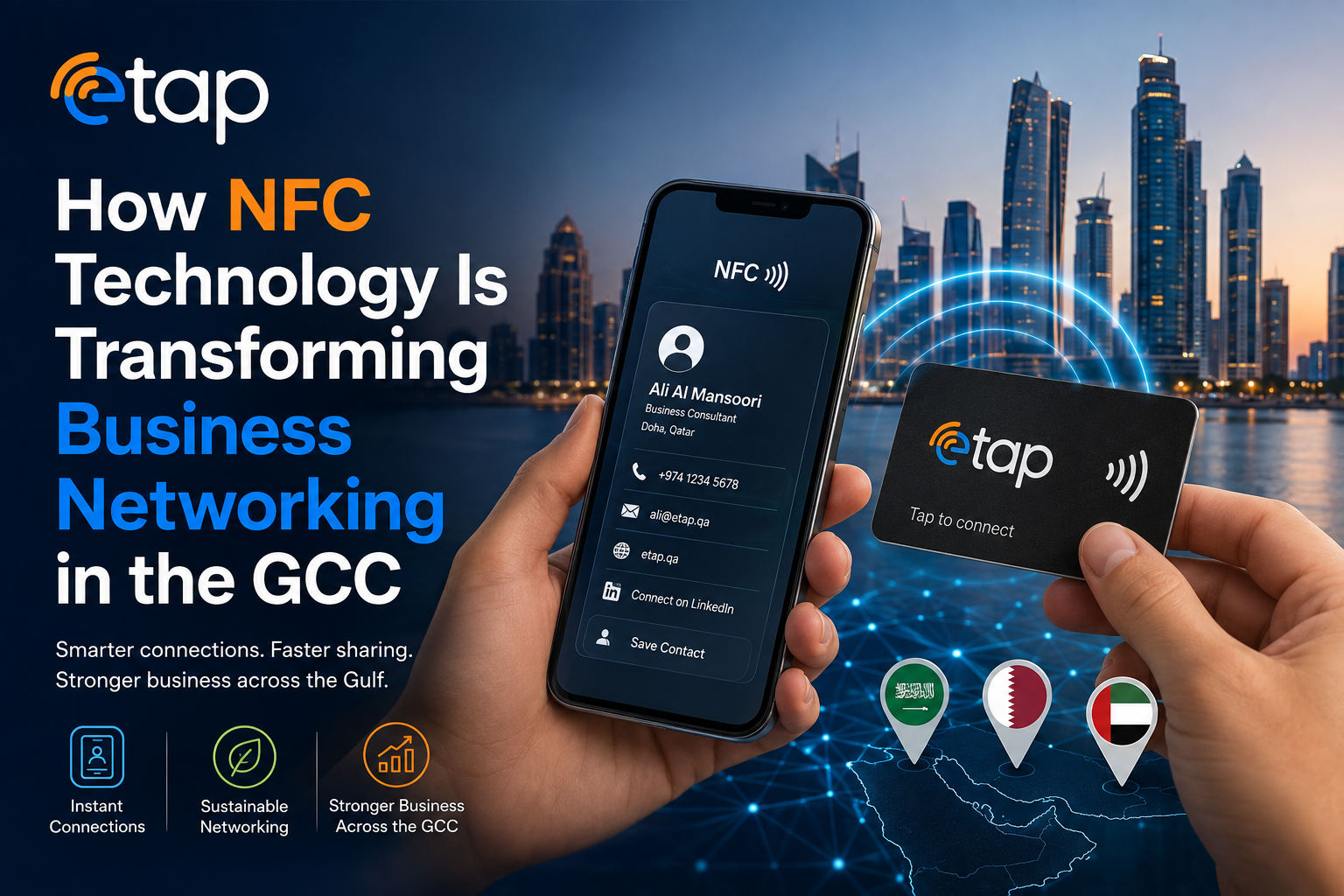
Business networking across the Gulf is becoming increasingly digital. From a meeting in Doha to a property viewing in Riyadh or a hospitality event in Dubai, professionals expect information to move quickly, securely and with minimal friction.
That shift is helping Near Field Communication (NFC) move beyond payments. NFC-enabled business cards, review stands, loyalty tools, event check-in systems and smart-access solutions are creating new ways for businesses to turn a simple tap into a digital interaction.
For the GCC—particularly Qatar, the UAE and Saudi Arabia—this matters because the region already has strong digital infrastructure and consumers who are comfortable with contactless experiences.
The GCC Is Already a Contactless-First Region
The global benchmark shows just how mainstream contactless technology has become. Mastercard reported in 2025 that contactless payments represented more than two-thirds of in-person transactions globally on its network, compared with roughly one-third before the pandemic.
GCC markets have demonstrated similarly strong adoption. A Mastercard study found that 82% of surveyed UAE consumers considered contactless their preferred payment method, while 73% had moved a contactless card to the top of their wallet.
Saudi Arabia provides another powerful indicator of digital readiness. According to the Saudi Central Bank, electronic payments represented 79% of total retail payments in 2024, up from 70% in 2023, with 12.6 billion electronic non-cash transactions recorded during the year.
Qatar has also built extensive digital-payment infrastructure. Qatar Central Bank’s retail payment ecosystem supports card transactions, e-commerce, mobile payments and tokenised transactions through services such as Apple Pay, Samsung Pay and Google Pay.
This creates an important opportunity: NFC networking does not require GCC consumers to learn an entirely new behaviour. They already understand the concept of tapping a device. The same simple interaction can now be used to exchange professional information, open a website, save a contact or access a digital experience.
Three Industries Driving NFC Adoption
1. Hospitality
Hotels, resorts and hospitality groups operate in an environment where guest experience is everything.
An NFC touchpoint can connect guests to restaurant menus, concierge services, room information, WhatsApp support, feedback forms or loyalty programmes without requiring an app download.
Instead of searching for a URL or typing a long web address, a guest simply taps.
For international visitors attending conferences, exhibitions and sporting events across the Gulf, this frictionless approach can be particularly valuable.
2. Corporate Networking
Traditional business cards remain useful, but they have an obvious limitation: once printed, the information is static.
An NFC digital business card changes that model. A professional can tap an NFC card or device against a compatible smartphone and instantly open a digital profile containing their name, role, phone number, email, website, LinkedIn profile and other relevant information.
The card itself does not need to change every time a job title, telephone number or website changes.
For sales teams, consultants, executives and entrepreneurs attending GCC trade shows and business events, this turns a business card from a piece of printed material into a live networking asset.
3. Food & Beverage
Restaurants and cafés can use NFC touchpoints for much more than menus.
A table stand can direct customers to Google reviews, loyalty programmes, social media, ordering pages or promotional campaigns. A strategically positioned NFC stand can turn the moment immediately after a positive dining experience into an opportunity for customer engagement.
The principle is simple:
Good experience → tap → digital action.
The same infrastructure can support repeat visits and customer retention rather than simply collecting a one-time review.
NFC and the Sustainability Agenda
Digital business cards also have a sustainability dimension.
A conventional networking strategy can involve repeatedly printing cards whenever employees join a company, change positions, or update contact information. Digital alternatives reduce the need for that ongoing physical replacement.
However, sustainability claims should be made carefully. A 2015 life-cycle assessment comparing paper and software-based business cards found that the environmental advantage depends on scale and usage: digital cards became more environmentally favourable under the study’s larger, real-world scenario.
That nuance is important.
For Qatar, the broader direction is clearly aligned with national sustainability objectives. Qatar National Vision 2030 identifies environmental development as one of its four pillars, with an emphasis on balancing economic growth with environmental protection.
Qatar’s current environmental strategy also explicitly promotes circular-economy principles, resource efficiency, green development and digital transformation.
NFC is therefore not a sustainability solution by itself. But replacing frequently discarded printed materials with reusable digital touchpoints can be one small, practical part of a broader digital-first strategy.
Case Study: Turning a Restaurant Tap Into More Reviews
Consider a Doha restaurant introducing NFC review stands at selected tables.
After finishing a meal, a satisfied customer sees a small NFC stand beside the table. Instead of asking a waiter for a review link, the customer taps their phone and is taken directly to the restaurant’s digital review page.
Over a 60-day pilot, the restaurant could track:
- NFC interactions
- Review-page visits
- Reviews generated
- Repeat customer engagement
- Loyalty sign-ups
- Campaign conversion rates
A target such as 200 Google reviews in 60 days can be used as a campaign benchmark, but it should not be presented as a guaranteed result. Actual performance depends on customer volume, service quality, placement, staff participation, and the ease of the review journey.
The bigger lesson is that NFC provides measurable digital touchpoints where previously there was often only a printed card, sticker or verbal request.
What’s Next for NFC in Qatar and the GCC?
The next stage of NFC adoption is likely to be less about the technology itself and more about what businesses connect to it.
Loyalty programmes
An NFC tap could open a customer’s loyalty profile, membership page or rewards experience, creating a bridge between physical locations and digital CRM systems.
Event check-in
Conferences, exhibitions and corporate events can use NFC-enabled credentials to simplify registration, attendee identification and access to digital event information.
Smart offices
NFC can also support controlled access and employee experiences, depending on the underlying security infrastructure. From visitor management to room access and authentication, NFC can become part of a broader smart-office environment.
Digital networking
Perhaps the most accessible application remains the digital business card. For a professional working across Qatar, Saudi Arabia or the UAE, one tap can replace the exchange of printed cards and immediately establish a digital connection.
The GCC’s Next Networking Standard
The GCC’s digital transformation is creating an environment where tap-based interactions feel natural. Contactless payments have already demonstrated that consumers are comfortable connecting physical experiences with digital services.
NFC business networking takes that behaviour one step further.
For companies, the opportunity is not simply to replace paper. It is to create faster, measurable and updateable interactions between people, brands and digital services.
As Qatar, the UAE and Saudi Arabia continue investing in digital infrastructure, NFC is well positioned to become a quiet but powerful layer of everyday business interaction—from the conference room and hotel lobby to the restaurant table and corporate office.