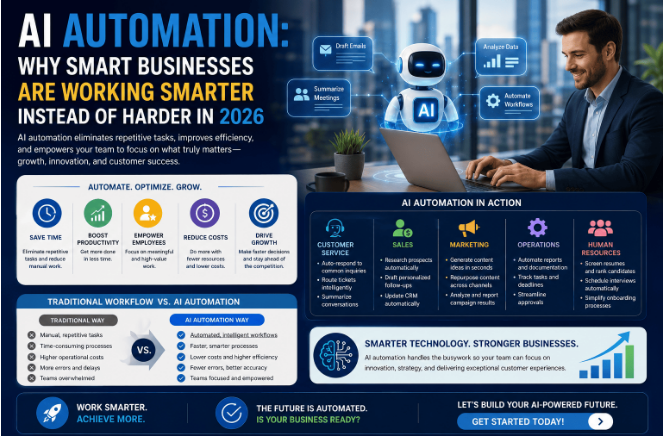
Every business reaches a point where growth creates new challenges.
More customers mean more emails to answer. More employees create additional administrative work. More projects require better coordination. Before long, teams spend more time managing routine tasks than focusing on innovation and business growth.
For years, companies solved this problem by hiring more people or purchasing additional software. While those strategies helped, they also increased operating costs and added complexity. Today, businesses are taking a different approach. They’re turning to AI automation to eliminate repetitive work, improve efficiency, and help employees focus on higher-value activities.
Artificial intelligence has evolved from a futuristic concept into a practical business tool. Companies of every size now use AI to streamline operations, improve customer experiences, and make faster decisions. The organizations seeing the biggest results aren’t simply adopting AI. They’re integrating AI automation into the way they work every day.
AI Automation Is More Than Traditional Automation
Many people confuse automation with artificial intelligence, but they are not the same.
Traditional automation follows fixed rules. It completes repetitive tasks based on predefined instructions. For example, an invoice might automatically be forwarded to the finance department or a welcome email might be sent after someone fills out a contact form.
AI automation goes much further.
Instead of following only fixed rules, AI can understand language, recognize patterns, analyze information, and recommend actions based on context. It can summarize meetings, draft emails, organize documents, classify customer inquiries, generate reports, and even assist with business decision-making.
This added intelligence allows organizations to automate work that once required significant human effort.
Why Businesses Are Prioritizing AI Automation
Business leaders are under constant pressure to increase productivity while controlling costs. At the same time, customers expect faster responses, personalized experiences, and seamless service.
These expectations have made operational efficiency more important than ever.
Recent workplace research shows that AI adoption continues to accelerate across industries. Organizations are using AI in customer service, marketing, finance, operations, human resources, and software development to improve productivity and reduce repetitive work.
For many businesses, the goal is not replacing employees. It is helping employees accomplish more during the workday.
When routine tasks take less time, teams can focus on strategy, creativity, relationship building, and problem-solving. These are the activities that create lasting competitive advantages.
The Hidden Cost of Manual Processes
Many companies underestimate how much time is lost to repetitive administrative work.
Think about a typical workday.
Employees answer similar emails multiple times.
Managers summarize meetings and prepare reports.
Sales teams manually update customer records.
Marketing departments rewrite existing content for different channels.
Human resources professionals organize resumes, schedule interviews, and prepare onboarding documents.
Each task may only take a few minutes, but together they consume hundreds of hours every month.
As businesses grow, these inefficiencies become more expensive.
Hiring additional employees may solve the immediate problem, but it also increases payroll costs and creates more administrative responsibilities.
AI automation tools address the root cause by reducing unnecessary manual work while allowing employees to focus on activities that require human expertise.
AI Automation Supports People, Not Replaces Them
One of the biggest concerns surrounding artificial intelligence is job displacement.
In reality, successful organizations use AI to strengthen their workforce rather than reduce it.
A customer service representative uses AI to draft responses but still provides empathy and personalized support.
A salesperson relies on AI to research prospects and prepare follow-up emails but continues building relationships with clients.
A marketing manager uses AI to generate campaign ideas but applies creativity, strategy, and brand knowledge before publishing content.
The technology handles repetitive work. People continue making important decisions, solving complex problems, and building meaningful customer relationships.
Businesses that understand this balance are seeing stronger employee adoption and greater long-term success.
The Real Competitive Advantage
Technology alone has never been the deciding factor in business success.
Competitive advantage comes from how effectively organizations use technology to improve everyday operations.
Companies that successfully implement AI automation create faster workflows, improve communication, reduce operational costs, and free employees to focus on meaningful work. Over time, these improvements compound, allowing businesses to grow without increasing complexity at the same pace.
That is why AI automation has become more than another technology trend. It has become a strategic business capability that helps organizations stay agile in an increasingly competitive market.
Where AI Automation Delivers the Greatest Business Value
One of the biggest advantages of AI automation is its flexibility. It is no longer limited to large enterprises with dedicated IT departments. Today, businesses of every size can automate repetitive work and improve efficiency across multiple departments.
The key is identifying processes that consume time without adding significant value. These are often the easiest opportunities for AI to create an immediate return on investment.
Sales and Business Development
Sales teams spend a surprising amount of time on administrative tasks.
Researching prospects, writing follow-up emails, updating customer records, preparing proposals, and scheduling meetings often reduce the time available for selling.
AI automation helps sales professionals by:
- Drafting personalized outreach emails
- Summarizing customer meetings
- Creating sales proposals
- Updating CRM records
- Prioritizing qualified leads
- Scheduling follow-ups
Instead of replacing sales representatives, AI allows them to spend more time building relationships and closing deals.
Marketing and Content Creation
Marketing teams are expected to produce more content than ever before.
Blog articles, email campaigns, landing pages, social media posts, advertising copy, newsletters, and product descriptions all require time and creativity.
AI automation accelerates these workflows by helping marketers:
- Generate content ideas
- Create first drafts
- Repurpose existing content
- Research keywords
- Summarize market trends
- Analyze campaign performance
The result is faster execution without sacrificing strategic thinking or brand consistency.
Customer Service
Customers value quick, accurate responses.
AI automation supports customer service teams by organizing support tickets, drafting replies, answering frequently asked questions, and routing inquiries to the appropriate department.
Support representatives remain in control of customer interactions while AI reduces repetitive work behind the scenes.
This leads to shorter response times, improved consistency, and higher customer satisfaction.
Human Resources
HR departments manage large volumes of information every day.
Recruitment, onboarding, policy updates, employee communication, and documentation all require careful attention.
AI automation can assist by:
- Writing job descriptions
- Screening resumes
- Summarizing interviews
- Creating onboarding documents
- Answering common employee questions
- Organizing HR records
These improvements allow HR professionals to focus on employee development and workplace culture instead of repetitive administrative work.
Finance and Operations
Finance teams depend on accuracy and efficiency.
AI automation helps organize invoices, summarize financial reports, monitor recurring expenses, identify unusual spending patterns, and support forecasting.
Operations teams benefit from automated reporting, workflow optimization, document management, and project tracking.
When combined, these improvements reduce delays and create smoother business operations.
Common Mistakes Businesses Make with AI Automation
Although AI offers significant opportunities, implementation mistakes can limit its impact.
Understanding these challenges helps organizations build a stronger foundation for success.
Buying Tools Without a Strategy
Many businesses purchase AI software simply because competitors are using it.
Without clear business objectives, teams often struggle to understand how the technology fits into existing workflows.
Every AI initiative should begin by identifying business problems rather than selecting software.
Trying to Automate Everything at Once
Successful AI adoption happens gradually.
Businesses that attempt to automate every process simultaneously often overwhelm employees and create unnecessary complexity.
Starting with one department or one repetitive workflow allows teams to build confidence before expanding AI across the organization.
Ignoring Employee Training
Technology alone does not improve productivity.
Employees need practical guidance on how to use AI effectively, verify AI-generated information, and protect confidential business data.
Organizations that invest in training generally experience faster adoption and stronger long-term results.
Forgetting Human Oversight
AI produces valuable recommendations, but it should not replace human judgment.
Important business decisions, customer communication, financial reporting, and legal documentation should always include human review.
The most successful organizations combine AI speed with human expertise.
How to Build an AI Automation Strategy
Businesses do not need a complete digital transformation to benefit from AI.
Small, measurable improvements often deliver the strongest results.
A practical strategy usually begins with four simple steps.
Identify Repetitive Tasks
Look for work that employees perform every day.
Examples include:
- Email responses
- Meeting summaries
- Report creation
- Document organization
- Customer follow-ups
- Data entry
- Appointment scheduling
These activities provide excellent opportunities for automation.
Prioritize High-Impact Processes
Not every workflow needs AI.
Focus on tasks that consume the most time or create bottlenecks across multiple departments.
Improving these processes typically delivers the fastest return on investment.
Measure Results
Track measurable outcomes such as:
- Hours saved
- Faster response times
- Improved customer satisfaction
- Increased employee productivity
- Reduced operational costs
- Higher workflow accuracy
Measuring progress helps businesses understand which automation initiatives deliver the greatest value.
Continue Improving
AI technology evolves rapidly.
Businesses should regularly evaluate workflows, gather employee feedback, and identify new opportunities for automation.
Continuous improvement ensures AI remains aligned with changing business goals and customer expectations.
By taking a structured approach, organizations can build sustainable AI capabilities instead of chasing short-term technology trends.
The Future of AI Automation Is Already Here
The next phase of AI automation is not about doing more tasks. It is about helping businesses make better decisions.
Over the next few years, AI will become more proactive. Instead of waiting for instructions, AI systems will identify bottlenecks, recommend improvements, predict business trends, and coordinate workflows across multiple platforms.
This evolution is already changing how organizations operate.
Businesses are beginning to use AI to forecast inventory needs, identify customer behavior patterns, detect financial risks, optimize supply chains, and improve employee productivity. As these technologies continue to mature, companies that have already built an AI-ready culture will be in a much stronger position than those just beginning their journey.
The competitive advantage will no longer come from simply having access to AI. It will come from knowing how to integrate AI into everyday business operations.
AI Automation Is a Long-Term Business Strategy
Many business leaders still view artificial intelligence as another software investment. In reality, it is a long-term operational strategy.
The most successful organizations are not asking, “Which AI tool should we buy?”
Instead, they are asking:
- Which processes consume the most time?
- Where are employees spending hours on repetitive work?
- How can AI improve customer experiences?
- Which workflows limit business growth?
These questions shift the conversation away from technology and toward measurable business outcomes.
Organizations that focus on solving business challenges instead of chasing the latest AI trends are more likely to achieve sustainable results.
Preparing Your Business for the Next Wave of AI
Every business has opportunities to improve efficiency, but success starts with preparation.
Before implementing AI automation, business leaders should:
- Review existing workflows.
- Identify repetitive and time-consuming tasks.
- Prioritize processes that deliver measurable business value.
- Train employees to use AI responsibly.
- Establish clear governance and data security policies.
- Measure performance regularly and refine workflows over time.
This structured approach reduces risk while creating a strong foundation for future growth.
Businesses do not need to automate everything overnight. Many of the biggest improvements come from solving one problem at a time and expanding gradually as teams gain confidence.
The Human Side of AI Automation
One concern that continues to surface is whether AI will replace people.
The reality is much more balanced.
AI is exceptionally good at processing information, identifying patterns, and completing repetitive tasks. People remain essential for leadership, creativity, emotional intelligence, strategic thinking, and relationship building.
Organizations that achieve the best outcomes combine these strengths.
Employees spend less time on routine administration and more time solving customer problems, developing new ideas, mentoring colleagues, and creating value that technology alone cannot deliver.
When AI supports people instead of replacing them, everyone benefits. Businesses become more productive, employees experience less repetitive work, and customers receive faster, more personalized service.
Why Businesses Are Turning to Experienced AI Partners
Implementing AI successfully requires more than choosing the right software. It involves understanding business processes, integrating technology with existing systems, and ensuring employees can use AI effectively.
That is why many organizations choose experienced AI partners to guide their transformation.
Cevra AI helps businesses identify automation opportunities, develop practical AI strategies, and implement intelligent solutions that improve efficiency without disrupting day-to-day operations. From workflow optimization and AI consulting to custom automation solutions and team enablement, the focus is always on delivering measurable business outcomes.
Rather than adopting AI for the sake of innovation, successful organizations implement it where it creates lasting value.
Frequently Asked Questions
What is AI automation?
AI automation combines artificial intelligence with automated workflows to complete repetitive tasks, analyze information, and support business decision-making with minimal manual effort.
How does AI automation differ from traditional automation?
Traditional automation follows predefined rules, while AI automation can understand language, recognize patterns, learn from data, and make intelligent recommendations based on context.
Which businesses benefit from AI automation?
Businesses of all sizes can benefit from AI automation, including healthcare providers, financial firms, manufacturers, retailers, professional services, logistics companies, and technology startups.
What are the biggest benefits of AI automation?
The main benefits include improved productivity, reduced operational costs, faster customer service, fewer manual errors, better decision-making, and increased business scalability.
How should a business begin with AI automation?
Start by identifying repetitive workflows, selecting high-impact processes, training employees, measuring results, and expanding automation gradually as your organization gains experience.
Conclusion
The way businesses operate is changing faster than ever. Growing customer expectations, increasing workloads, and the demand for greater efficiency mean organizations can no longer rely solely on manual processes.
AI automation provides a practical way to simplify operations, improve productivity, and help employees focus on the work that matters most. Whether it is streamlining customer service, accelerating marketing efforts, supporting sales teams, or optimizing internal workflows, AI is becoming an essential part of modern business strategy.
However, technology alone is not enough. Lasting success comes from combining the right ai tools with a clear strategy, skilled employees, and a commitment to continuous improvement.
Businesses that start their AI journey today will be better prepared to adapt, compete, and grow in the years ahead. Those that delay risk falling behind as competitors continue to improve efficiency and deliver better customer experiences.
Organizations looking to unlock the full potential of AI often work with experienced partners like Cevra AI to build practical automation strategies, implement scalable solutions, and create a strong foundation for long-term digital transformation.
The future of business is not about replacing people with technology. It is about empowering people with intelligent tools that help them work smarter, innovate faster, and build stronger organizations.