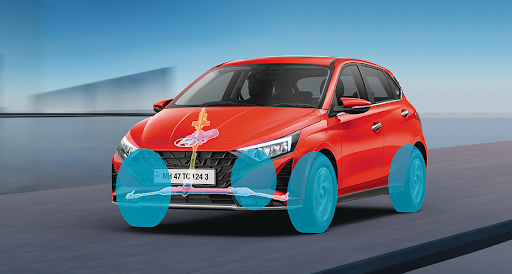
Safety is an important factor when selecting a car for use on city roads and highways in India. The new Hyundai i20 safety approach focuses on combining essential protection systems with well-integrated technology to support control and awareness. Instead of relying on a single layer, it brings together multiple systems that work in coordination. With a focus on quality and innovation, the i20 remains a preferred choice for people who value safety and performance on the road.
Airbags and Occupant Protection Systems
The Hyundai i20 safety prioritises passenger comfort by integrating multiple restraint and cushioning systems. It features a passenger protection system with 6 airbags, including front, side, and curtain airbags for more protection coverage. It includes seatbelt pretensioners for front occupants, along with 3-point seatbelts and seatbelt reminders for all seats to support proper restraint. ISOFIX child seat anchors are also included for secure child seat installation.
These features are designed to provide better restraint for all passengers, including children, especially in high-traffic conditions where sudden braking is common.
Braking System and Stability Control Systems
The Hyundai i20 includes advanced braking and stability systems designed to support control across different road conditions. It comes with an Anti-lock Braking System (ABS) and Electronic Brakeforce Distribution (EBD) to manage braking force and prevent wheel lock during sudden stops. Electronic Stability Control (ESC) and Vehicle Stability Management (VSM) maintain directional control, while Hill Assist Control (HAC) prevents rollback on inclines.
These systems function together to improve control and reduce the instability during critical driving moments, ensuring more predictable handling.
Monitoring and Preventive Safety Features
The Hyundai i20 includes features that improve awareness by helping monitor surroundings and vehicle conditions:
- A Tyre Pressure Monitoring System that displays real-time tyre conditions directly on the Multi-Information Display (MID).
- Rear parking sensors integrated into the bumper provide reliable object detection while driving.
- A rear camera to assist the driver in reversing the car with high precision and accuracy.
- The Driver Rear View Monitor (DRVM) improves visibility of the area behind the car even while moving forward.
- The day and night inside rear view mirror allows the driver to adjust the reflection to reduce glare from trailing headlights manually.
By improving visibility and providing timely alerts, these features help reduce the chances of avoidable errors during everyday driving and parking situations.
Alert and Emergency Response Features
The Hyundai i20 is designed to respond immediately to a risk situation. These features notify surrounding vehicles and support quicker response when required:
- The Emergency Stop Signal (ESS) automatically flashes the light cluster to alert following vehicles during instances of sudden braking.
- An impact-sensing auto door unlock feature ensures that passengers can quickly exit after a collision.
- The speed-sensing auto door lock system enhances passengers’ security by automatically engaging the locks once the vehicle reaches a certain speed.
- A dedicated speed alert system notifies the driver with audible warnings whenever speed limits are exceeded.
- The integrated burglar alarm immediately alerts the owner in case of unauthorised access to the vehicle.
- An immobiliser system prevents the engine from starting unless the correct key is used.
These features enhance safety by addressing situations that require immediate attention, protecting the people in the car.
Smart Safety Enhancements Features in i20
Some features of the Hyundai i20 improve safety by integrating technology with convenience, making everyday driving more responsive and controlled across different scenarios:
- Hyundai Bluelink buttons are located within reach to provide instant access to SOS services.
- Automatic headlamps use sensors to detect low-light conditions and engage the lights for better visibility.
- The headlamp escort function keeps the lights on for a short time after parking, improving visibility as you walk away from the car.
- The central locking system allows closed-door management from a single master control.
These i20 features enhance safety by reducing manual intervention and enabling timely responses, particularly under changing lighting and traffic conditions.
How These Systems Work Together
The overall Hyundai i20 safety features are built on integrating multiple systems rather than relying on individual features. Airbags and seatbelts protect the passengers, while braking and stability systems support control. The monitoring features improve awareness, and alert systems respond to sudden situations.
When these features function together, they create a balanced safety setup that supports driving across different conditions. This combination helps address multiple safety aspects at once, ensuring a more stable and controlled driving experience.
Conclusion
The new Hyundai i20 combines protection, control, monitoring, and alert systems to provide safer driving across different environments. It shows how a hatchback design can combine luxury and safety while delivering a strong performance. Each feature in the car serves a specific purpose, driven by innovation and safety. Hyundai ensures that the i20 remains the preferred choice for buyers by designing it to meet evolving needs and usage patterns.