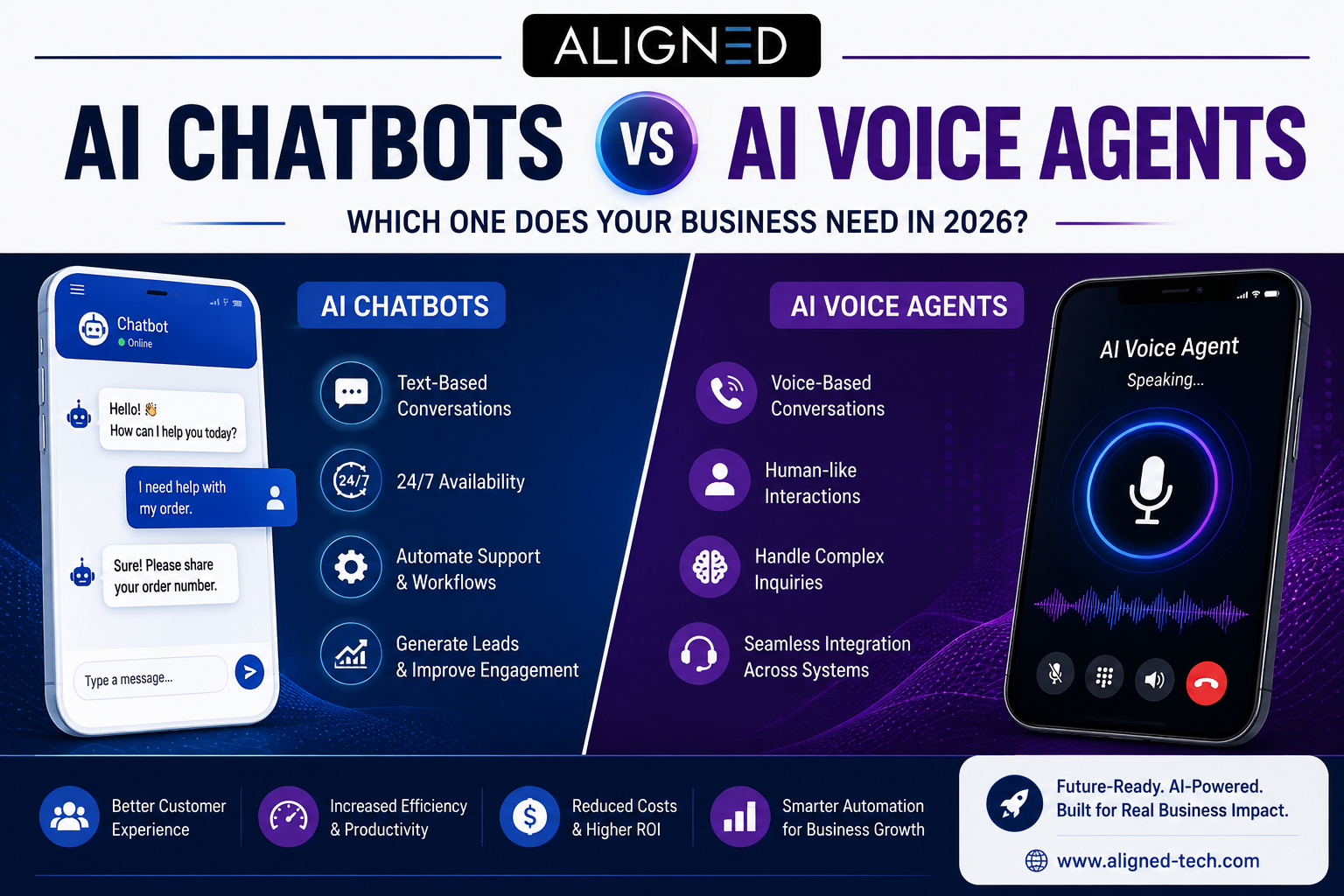
Businesses are rapidly adopting conversational artificial intelligence to improve customer communication, automate repetitive tasks, and create faster service experiences. Two technologies receiving particular attention in 2026 are AI chatbots and AI voice agents.
Both technologies allow businesses to communicate with customers using natural language, but they serve different purposes. AI chatbots primarily operate through text-based conversations, while AI voice agents use spoken conversations over phone or voice channels.
Choosing between them isn’t simply a question of which technology is newer or more advanced. The right solution depends on the business model, customer preferences, existing workflows, and the type of interaction a company wants to automate.
Understanding AI Chatbots
An AI chatbot is a software system designed to communicate with users through text. It can be deployed on websites, applications, messaging platforms, and other digital channels.
Traditional chatbots generally rely on predefined rules and decision trees. Modern AI chatbots, however, can use natural language processing, machine learning, large language models, and business knowledge bases to understand a wider range of customer questions.
For example, instead of requiring a customer to select a specific menu option, an AI chatbot can understand requests such as:
“I’d like to know whether I can schedule a consultation next week.”
The chatbot can identify the intent behind the request and guide the customer toward an appropriate action.
Common AI Chatbot Applications
Businesses use AI chatbots for a variety of purposes, including:
- Answering frequently asked questions
- Providing product and service information
- Capturing leads
- Qualifying prospects
- Scheduling appointments
- Supporting customers
- Collecting customer information
- Providing order updates
- Guiding users through websites
- Connecting customers with human representatives
The major advantage is accessibility. Customers can start a conversation without waiting for an employee to become available.
Understanding AI Voice Agents
AI voice agents bring conversational AI into phone-based communication.
Instead of typing a question into a website chatbot, customers can speak naturally with an AI-powered voice system. The technology typically combines speech recognition, artificial intelligence, language processing, text-to-speech technology, and integrations with business systems.
A voice agent can understand spoken requests, ask follow-up questions, provide information, and in suitable workflows trigger actions.
For example, a customer could call a business and say:
“I need to move my appointment from Tuesday to Thursday.”
A properly integrated voice agent could understand the request, verify the customer’s information, check availability, and assist with rescheduling.
This makes voice AI particularly interesting for businesses that receive a high volume of phone enquiries.
AI Chatbots vs AI Voice Agents
The fundamental difference is the communication channel, but the business implications go further.
| Feature | AI Chatbots | AI Voice Agents |
|---|---|---|
| Communication | Text | Voice |
| Main channels | Websites, apps, messaging | Phone and voice systems |
| Best suited for | FAQs, support, lead generation | Calls, bookings, follow-ups |
| Customer interaction | Typing and reading | Speaking and listening |
| Availability | 24/7 | 24/7 with suitable infrastructure |
| Workflow integration | Yes | Yes |
| Human escalation | Chat transfer | Call transfer |
| Ideal environment | Digital-first businesses | Phone-heavy businesses |
Neither solution is universally better. The right option depends on how customers prefer to communicate.
When Should a Business Choose an AI Chatbot?
An AI chatbot can be a strong choice when most customer interactions already happen online.
For example, an e-commerce company may receive hundreds of daily questions about delivery, product availability, returns, and payment options. A chatbot can handle many of these routine questions while allowing human support representatives to focus on complex cases.
A chatbot can also be useful for businesses that want to capture website visitors as leads.
A visitor might ask about pricing. The chatbot can answer the question, ask about the visitor’s requirements, collect contact details, and pass the information to a sales representative.
This creates a complete digital customer journey rather than simply providing automated answers.
When Should a Business Choose an AI Voice Agent?
Voice agents are particularly valuable when telephone communication is an important part of the customer journey.
Consider industries such as:
- Healthcare
- Real estate
- Hospitality
- Financial services
- Education
- Travel
- Home services
- Professional services
Customers in these industries may prefer speaking with someone rather than typing.
For example, a real estate company could use a voice agent to answer property enquiries, qualify potential buyers, arrange viewing appointments, and conduct follow-up calls.
Similarly, a restaurant could use voice automation to handle reservation enquiries during busy periods.
The Role of AI in Customer Service
Customer expectations have changed significantly. People increasingly expect businesses to respond quickly and provide convenient communication channels.
AI can help organizations meet these expectations without requiring employees to manually handle every interaction.
A chatbot can respond immediately to a website visitor.
A voice agent can answer a phone call without putting the customer on hold.
Both can help businesses provide service outside conventional office hours.
However, automation should not mean removing humans from the customer experience completely.
Complex complaints, sensitive situations, negotiations, and unusual requests may still require human expertise.
The strongest approach is often a combination of AI and human support.
Human Handoff Is Essential
One common mistake in conversational AI implementation is trying to make the system handle every possible situation.
A better approach is to define clear escalation rules.
For example, if a chatbot doesn’t understand a customer’s request after several attempts, it can offer a human representative.
Similarly, if a voice agent encounters a complex issue, it can transfer the call to an employee.
This creates a hybrid customer-service model:
AI handles routine interactions → Human employees handle complex situations.
Such an approach can improve efficiency without sacrificing the personal element of customer service.
Connecting AI With Business Workflows
The real potential of conversational AI appears when chatbots and voice agents connect with other business systems.
Imagine a customer contacting a company through an AI chatbot.
The conversation could trigger the following workflow:
Customer enquiry → AI understands request → Customer information collected → CRM updated → Lead assigned → Sales team notified
The same concept can be applied to voice.
A customer could call an AI voice agent to request an appointment. The system could collect the required details, connect with a scheduling platform, confirm availability, and send the customer a confirmation.
This is more powerful than simply answering questions.
The AI becomes part of the company’s operational workflow.
AI Automation Can Reduce Repetitive Work
Employees often spend significant amounts of time on repetitive activities.
These may include:
- Answering the same questions
- Entering customer information
- Making reminder calls
- Scheduling appointments
- Sending routine follow-ups
- Updating CRM records
- Categorizing enquiries
Automating these activities can give employees more time to focus on strategic and customer-facing work.
The objective isn’t necessarily to replace employees. Instead, businesses can use AI to remove repetitive administrative workloads and allow employees to concentrate on activities requiring judgment, creativity, and relationship-building.
Choosing Between Chatbots and Voice Agents
Businesses should consider several questions before selecting a conversational AI solution.
1. How Do Your Customers Prefer to Communicate?
If most customers interact through your website or messaging channels, a chatbot may be the logical starting point.
If customers frequently call your business, a voice agent may deliver greater value.
2. What Problem Are You Trying to Solve?
Don’t begin with the technology. Begin with the problem.
Is the goal to reduce support tickets? Generate leads? Handle appointments? Improve response times? Automate outbound calls?
The answer will influence the appropriate solution.
3. How Complex Is the Workflow?
Some use cases only require information retrieval.
Others require multiple steps and integrations.
A simple FAQ chatbot may require relatively little integration, while an AI system that schedules appointments, updates CRM records, and triggers notifications requires a much more connected architecture.
4. Where Is Human Intervention Required?
Businesses should identify situations where AI should stop and transfer the conversation to an employee.
This is particularly important for sensitive or high-value interactions.
Common AI Implementation Mistakes
Adopting conversational AI without proper planning can create problems.
One common mistake is trying to automate too much too quickly.
Another is launching a system without testing realistic customer conversations.
Businesses should also avoid giving AI access to unnecessary information or systems.
A successful implementation should include:
- Clear objectives
- Defined workflows
- Appropriate system access
- Security controls
- Human escalation
- Testing
- Performance monitoring
- Continuous improvement
AI should be treated as part of the business infrastructure rather than simply another software feature.
Why Testing Matters
An AI system may perform well during a demonstration but behave differently when exposed to real customers.
Users may:
- Ask unexpected questions
- Change topics
- Use incomplete sentences
- Make spelling mistakes
- Use slang
- Speak with different accents
- Provide contradictory information
Testing these scenarios before deployment can identify weaknesses.
Businesses should also monitor conversations after launch and use the results to improve the system.
Continuous optimization is an important part of successful AI adoption.
The Future of Conversational AI
AI chatbots and voice agents are likely to become increasingly connected to business systems.
Instead of simply answering questions, conversational AI will increasingly be used to perform tasks.
A customer might say:
“Find me an available appointment next Friday afternoon and book it.”
The AI could potentially understand the request, check availability, complete the booking, and provide confirmation.
Similarly, a sales prospect could interact with a chatbot that understands their requirements, recommends an appropriate service, qualifies the lead, and schedules a meeting.
This movement from conversation to action is one of the most important developments in business AI.
How Businesses Can Start
Businesses don’t need to deploy a complex AI system immediately.
A practical approach is to start with one repetitive, measurable process.
For example:
- Identify a high-volume customer interaction.
- Analyze how employees currently handle it.
- Determine which parts can be automated.
- Choose a chatbot or voice-based solution.
- Connect the necessary business systems.
- Test realistic scenarios.
- Launch with human support available.
- Measure the results.
- Improve the system.
- Expand automation gradually.
Starting small allows businesses to learn what works before making larger investments.
Conclusion
AI chatbots and AI voice agents are becoming valuable tools for businesses looking to improve customer communication and automate repetitive processes.
Chatbots are particularly effective for digital, text-based interactions, while AI voice agents can provide a natural alternative for businesses where phone communication remains important.
The choice shouldn’t be based simply on which technology is more advanced. Businesses should consider their customers, workflows, goals, integrations, and operational requirements.
The most effective conversational AI strategy may ultimately combine both technologies.
For businesses exploring this transition, Aligned Tech focuses on practical AI solutions including AI chatbots, AI voice agents, workflow automation, cloud technology, and custom software integrations.
The future of customer communication isn’t just about machines answering questions. It’s about creating intelligent systems that can understand customers, perform useful tasks, and work alongside people to create better business outcomes.