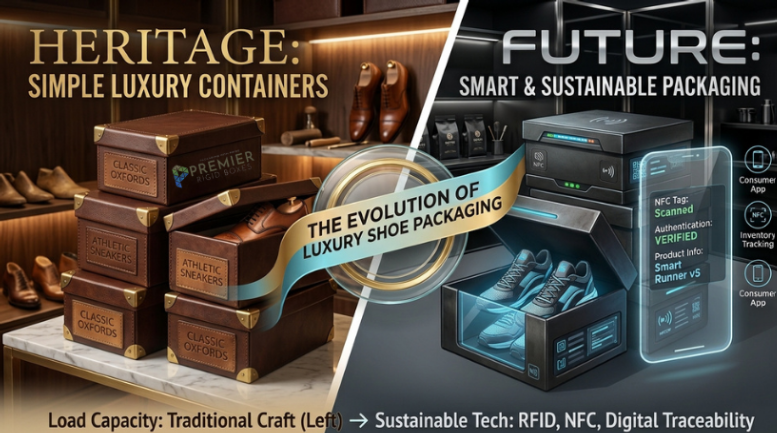
Most people don’t think twice about a shoe box. You open it, pull the shoes out, and the box either gets tossed or shoved under the bed. But that plain cardboard container has a far longer, more interesting history than it gets credit for.
For manufacturers and retailers, though, it’s always mattered. It protects shoes in transit, keeps pairs together, makes warehouse storage manageable, and gives brands a surface to actually talk to customers. None of that happened by accident the shoe box evolved right alongside footwear manufacturing, retail, and shipping. As shoes went from something a cobbler made one pair at a time to something churned out by the thousands, the packaging had to keep up.
These days a shoe box might be nothing more than a basic container, or it might be a carefully engineered shipping package, a branding tool, or even part of the unboxing experience itself.
Why Did Anyone Need a Shoe Box in the First Place?
Go back far enough, and shoes were made one pair at a time by a local cobbler. A customer placed an order, waited, and walked away with the finished pair. There was no real need for packaging, nothing to store, nothing to ship in bulk.
Once factories started turning out hundreds or thousands of pairs, someone had to figure out how to store them all. Shoes couldn’t just pile up around the workshop floor anymore. They needed protection from dust and handling, and they needed to be sorted, stacked, moved, and eventually shipped out to stores.
A box handled all of that at once. And once footwear started traveling real distances from factory to shelf, that protective function only got more important, which is really the whole reason the shoe box stuck around and became standard.
How Cardboard Packaging Actually Got Its Start
Paperboard and cardboard didn’t arrive fully formed; the packaging industry built them up over time.
Early cardboard boxes were pretty basic. They could hold shoes fine sitting still, but they weren’t built for repeated handling, and a bit of rough treatment could crush them.
The real turning point was corrugated board sandwiching a fluted layer of paper between two flat sheets. That simple structural trick made boxes far more rigid without piling on extra weight, which was a big deal for anyone shipping boxes by the thousands.
That same basic idea is still what most shoe boxes rely on today. It’s strong, it’s light, and manufacturing has only gotten better at producing it consistently at scale.
When the Box Became Part of the Retail Experience
As shoes stopped being just a necessity and became something tied to fashion and personal style, the box’s job changed, too.
Suddenly, it wasn’t just storage, it was marketing space. A logo here, a color scheme there, some product details on the side, and the box wasn’t anonymous anymore. Someone could spot a brand from across a stockroom just by recognizing the packaging.
It sounds obvious now, but that was a real shift in how companies thought about what a box was even for.
Why Design Started Mattering So Much
A corrugated shoe box is being asked to do several jobs simultaneously: protect the product, make transport and storage manageable, actually fit the shoes properly and for a lot of brands, look good doing it.
A poorly built box can cheapen a product before the customer even sees the shoes. A well-built one, on the other hand, can turn opening the box into part of the purchase itself, something premium footwear brands lean into hard. Someone paying a premium price expects more than a flimsy container; the printing, the finish, how it opens, even how the shoes sit inside, all shape that first impression. That’s why packaging decisions rarely stop at does it fit.
Corrugated Boxes and What They Do for Protection
Corrugated board remains one of the most practical solutions in footwear packaging strong enough to survive real handling, light enough not to add unnecessary shipping cost.
A pair of shoes might go from factory to distribution center, distribution center to store, and store to customer, getting stacked, loaded, unloaded, and handled at every stop along the way. The packaging has to hold up through all of that without becoming a burden to ship.
That matters even more for online orders, where a single pair is often handled far more individually than shoes bought off the shelf.
Looking Good Isn’t the Same as Working Well
A gorgeous shoe box isn’t automatically a good one and that’s a mistake brands make more often than you’d think.
Picture a box with beautiful printing and a premium finish but weak corners. It looks fantastic leaving the factory and then falls apart the first time it gets stacked five high in a warehouse. Or picture a box that’s noticeably bigger than the shoes inside now you need extra filler material, and shipping volume goes up for no real benefit.
Function has to come first. The look comes after the fundamentals are already solved.
Getting the Sizing Right
Because footwear isn’t one uniform shape, boxes can’t be either. Men’s shoes, women’s shoes, kids’ sizes, boots, sandals, sneakers, high-tops they all call for different dimensions.
The goal is a box that fits snugly enough to actually protect the shoes without leaving so much empty space that they shift around in transit. Too tight, and you risk pressure damage. Too loose, and the shoes bounce around during shipping. Neither is great.
Sizing also affects warehouse efficiency. The right dimensions make better use of shelving and stacking space, and for large manufacturers, even a small dimensional change adds up fast across thousands of units.
Not Every Box Opens the Same Way
The classic shoe box has a lift-off lid, simple, familiar, works fine. But it’s far from the only design out there.
Some brands use hinged lids. Others build in pull-out drawers or front-facing openings, which tend to work better in retail environments. Think about a store employee digging through a tall stack of boxes for one specific size with a standard lid, which might mean moving several boxes just to reach the one at the bottom. A pull-out design skips that entirely.
The “right” opening style really depends on how the box will be used day-to-day.
The Box as a Branding Tool
Packaging gives brands something a crowded shelf usually doesn’t: extra room to say something. A box’s exterior can carry a logo, brand colors, sizing, product details, care instructions, sustainability notes, even a website or social handle a surprising amount of information on a fairly small surface.
For premium footwear, that surface can also set a mood. Minimal graphics and a refined finish read as luxury. Bold colors and big type suit sports or streetwear brands. Natural, unbleached materials support brands leaning into simplicity or sustainability.
The box doesn’t need to shout to make an impression; sometimes the quieter design says more.
What Actually Makes a Shoe Box Strong
Thickness alone doesn’t determine strength. Structure does.
The type of board, how many layers it has, how the folds are shaped, how the corners are built, and how well the lid actually fits all of it affect how the box performs under real-world stress. For shipping, it needs to survive stacking and ordinary rough handling without failing.
Moisture matters too. Shoes pass through different environments on the way to the customer, so packaging choices should account for storage and transport conditions, especially for materials that don’t handle moisture, pressure, or contamination well.
Online Shopping Changed What People Expect
In a traditional store, a shoe box mainly needs to survive the trip from the warehouse to the shelf. Online, the box becomes part of the delivery itself, the customer sees it and touches it before they’ve even tried the shoes on.
It also has to survive the roughest leg of the journey: sorting facilities, delivery trucks, repeated handling by people who’ve never touched the product before.
That leaves online sellers walking a tightrope, protective without being oversized or heavy, professional-looking without inflating shipping costs, and still easy enough for a customer to open without a fight.
Sustainability Is Reshaping Packaging Choices
Like most industries, footwear is under more pressure to rethink packaging waste, and customers are noticing how much material comes with every order.
That doesn’t mean the box needs to disappear it still serves a real purpose. The challenge is designing it more responsibly: using the right amount of material, keeping dimensions efficient to cut shipping volume, choosing recyclable paper-based options where local systems support it, and, in some business models, building for reuse rather than one-time use.
The smarter approach looks at the whole lifecycle rather than fixating on one feature. A flimsy box that gets replaced constantly isn’t necessarily greener than a slightly sturdier one designed for reuse.
Why Retailers Care About Packaging Quality Too
Retailers need boxes that make their day-to-day work easier to stack, identify, move, and store. Clear labeling helps staff find the right size fast, consistent dimensions make better use of storage space, and sturdy construction means fewer collapsed stacks.
Shoppers never notice most of this. The people working behind the counter absolutely do and across thousands of products, small efficiencies add up to real time saved.
Life After the Sale
Here’s something worth noting: a lot of people keep their shoe boxes long after the shoes are unboxed. They become storage for other shoes, small accessories, documents, whatever needs a home.
That’s a quiet opportunity for brands. A box sturdy and attractive enough to keep around stays visible in someone’s home long after the purchase no need to make it elaborate, just good enough that tossing it feels like a waste.
Questions Worth Asking Before You Design One
- What kind of footwear are you packaging? Lightweight sandals don’t need what heavy boots need.
- How will it be shipped? Local retail distribution and international shipping call for very different builds.
- Will customers actually see the box? In-store display places greater emphasis on appearance.
- Is it going straight to the customer? If so, durability, size, weight, and the opening experience all matter more.
- Does it need to survive multiple uses? That might justify spending more on construction upfront.
- How central is branding to the experience? If the box is part of the story, printing and finish need to support that.
- What happens to it afterward? Worth thinking through recycling, reuse, and how much material you’re actually using.
The Bigger Picture
The shoe box’s history is really a story about an entire industry changing shape. Footwear went from small workshops to mass production. Retail networks grew. Shipping got more complicated. Branding became non-negotiable. Online shopping introduced a whole new set of delivery demands. And now sustainability is steering material choices too.
The box adapted at every turn. Brands today have more options than ever, different boards, structures, opening styles, printing methods, sizes, finishes. When a standard stock box doesn’t cut it, a packaging supplier like Premier Rigid Boxes can help work through those options.
But underneath all that, the basic job hasn’t changed much: protect the product, make handling easier, use materials wisely, and represent the brand in a way that actually fits the customer picking it up.
That’s really why this unremarkable little container has stuck around for so long. It’s not just something a pair of shoes sits inside it quietly ties together manufacturing, storage, shipping, retail, branding, and the customer’s whole experience in one small package.